

Note: For whatever reason this took me longer to put out there than it did to write. I think because it felt truly personal, it’s not an opinion, it’s not a list, but a method. While this works for me, it might not work for you, and that’s okay. It’s certainly not for everyone, nor should it be. But if it does help you, I’d love to hear from you, please let me know!

How do you know you’re feeling lost? There’s the literal interpretation, sure, but then there’s the one that doesn’t really make itself known. It’s not from a breakdown. It’s not even a bad week. It something that happens quietly overtime. It’s not dramatic, it’s just a feeling of something off.
There can be a few signs, a common one that I experience was how I felt getting dressed. Where you look in the mirror and don’t feel like yourself. Or when you stand in your closet looking at your clothes and not feel inspired.
Another moment was the inspiration I was saving. I’m always building mood boards, it’s something I do constantly for my job. So I’m typically archiving personal inspiration everyday, but I noticed when I look back at those personal boards, I lost the through-line that linked back to myself. My inspiration started coming from the ‘internet’ or algorithm instead of my own instincts. I’ve started to save visuals without asking why or going back to ask why if time didn’t allow in the moment. This ended up resulting in clutter, not inspiration.
There have been some other moments, but for the purpose of this post I’ll leave those two as examples for how I felt that something had drifted (and you might too).

Right now, my life is genuinely feeling full in the best way. I’m building a company, Draperie, with a talented friend and interior designer (who also just launched her substack). I’m shaping what Risette is becoming with my husband (sign-up to be notified when that launches here). I’m also feeling inspired in my current full-time role where I help launch fashion brands. There’s a lot happening, and most of it feels good and right and like it’s going somewhere.
But "a lot of good happening" has a way of pulling you in every direction until everything starts to blur. You move through your days without really being in them. Your taste slowly gets replaced by whatever's closest. You stop choosing and start just absorbing. You're not falling apart, but you're not really growing either. You're just kind of floating through it all.
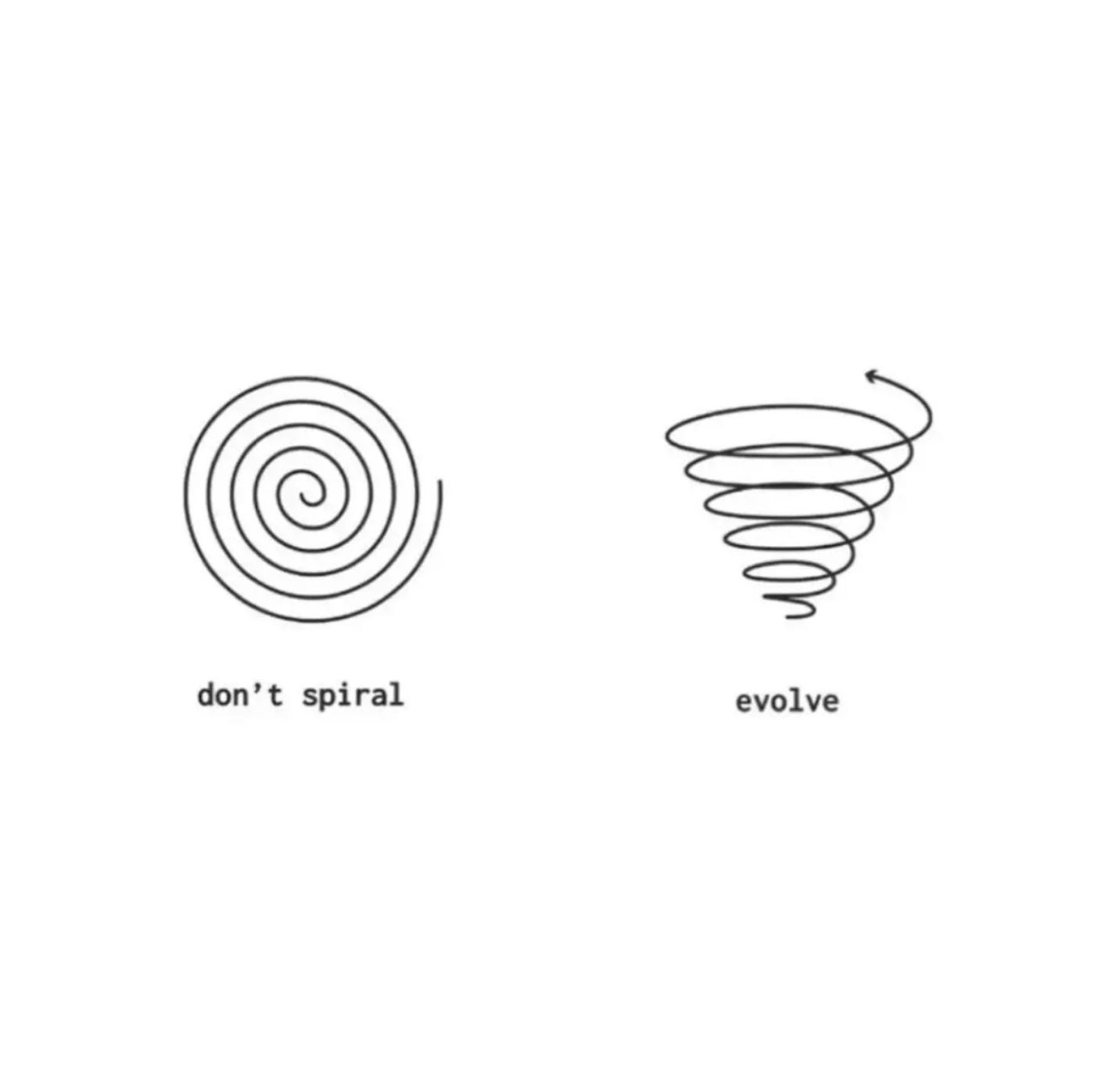
I came across this image in one of Studio Noto’s posts and something just clicked. The image shows two spirals, one flat and circular, labeled “don’t spiral,” and one moving upward and outward, labeled “evolve.” I kept coming back to it while writing this. The goal isn’t to avoid the discomfort of feeling out of sync. The goal is to let it take you somewhere instead of just going in circles.
That’s what a reset means to me. Not a reinvention. Not a new routine or a color-coded calendar. Just a check-in of does this still feel like me?

What I Feel Most Resets Get Wrong
Most reset methods start with change. Asking you to bring in a new habit or goal.
But that doesn’t really solve the problem. Because having a lack of habits or routine, isn’t really the issue (though that might be part of what you discover later). The problem is you’ve stopped paying attention to yourself and the gap between who you are and how you’re living has gotten too wide. With our access to the internet, we're constantly surrounded by other people's lives, other people's tastes and an endless stream of things to absorb. It's never been easier to lose yourself in all of that noise.
For example, you see something online, feel an instant pull toward it, and before long you've built a habit around it or bought into it completely. This is where the noise is taking over. Admiring something doesn't mean it belongs in your life. I can like something without it actually being mine. The same goes for a morning routine someone swears by, or a habit that looks great on paper. Borrowed pieces don't always fit.
So instead of starting with action, I like to start with observation.
I gather things. Images. Objects. Environments. I look at what I’ve been saving and I ask: what is it I’m actually responding to? The mood? The silhouette? The physical object in the image? Noticing the feeling an image gives me, not just the subject of it.
That distinction, between the surface of what I’m drawn to and what it actually means to me is how you can begin to find your way back.
To get the most out of this method, it’s important to move through it slowly. I’ve narrowed this down to six sections. I also created a worksheet for paid subscribers to follow along, return to, and use. Those subscribers can download it after the paywall, before section three. Okay, let's get into it.

Before You Begin: Gather First
Before any of the prompts, the worksheet asks you to do one thing: collect imagery, magazines, Pinterest, internet archives, whatever you actually use. Create loose sections: Inspiration, Wellbeing, Beauty, Style How I Want My Life to Feel, and Creative Energy.
It’s important to not analyze yet. Just collect what’s calling to you.
If you’re a visual person (and I suspect you are, or you probably wouldn’t be here), this step does more than you’d expect. Your saves are already telling you something. The worksheet just helps you hear what that is.

Now that you’ve begun to gather inspiration, the first section asks you to take inventory of how you feel. Maybe you learned something you are missing from the resources you gathered, like that you use to go on morning walks and haven’t or that quality time with loved ones is lacking and making you feel off. While you might not make a direct connection at this stage, it’s valuable to recognize whatever you’re feeling.
Everything in your life gets filtered through your wellbeing and how you’re feeling. Which means it’s worth looking at honestly. When you do this section, give yourself time to reflect over a couple days or even weeks. We really don’t believe a quick fix, so if you’re looking for a method to change everything over night, this might not be the one for you.
The worksheet asks:
How has my energy been lately?
What parts of my routine currently feel nourishing, and which quietly drain me?
When during the day do I feel most like myself? When do I feel calm and present?
What small change would make my day feel lighter?
The goal here isn’t to overhaul anything. It’s just to notice. You can’t adjust what you’re pretending isn’t there.

This section can only be as impactful as you are intentional with it.
There’s a huge distinction between being drawn to something and then understanding why. Sure there will always been those moments you can never quite put your finger on, and that’s okay. But when you start asking why as a practice, it's like finding the clue from lifting up a rock that was sitting right in front of you the whole time. You start to see that maybe you weren’t saving the look because you liked the exact outfit, instead it was the silhouette. Or it wasn’t the room you liked, it was the chair in the corner.
In then end, I'd save something, implement it into my life some way and feel less like myself. That happened because I saved it without asking why. When you look at inspiration only at surface level, you learn what draws you in, but not what’s underneath it all.
So this is where you really dive in. Go through each image or resource individually and call out specifically what it is you like. It can help to write directly on the image itself, circle, point, write out a note. Ask yourself: what specifically draws me to this? The silhouette, the mood, the color, the object, the atmosphere? Be as honest with yourself as you can here. Once completed, the worksheet asks:
What images, environments, or aesthetics have been catching my attention lately?
What themes appear repeatedly in what I save or admire?
We close this section with: something I’m realizing about my taste. That’s where your actual answer lives, not in the surface of what you saved, but in why.
This is a good place to pause. The next four sections are where the method gets specific, and where the worksheet becomes a real companion to this post. If you've been thinking about subscribing, this is a genuinely good moment, paid subscribers can download the worksheet below and open it alongside the rest of this.